FTSE Finish Line 8/6/26
FTSE Finish Line: June 8 — Geopolitics Hits Risk Appetite, but London Claws Back to Green
The FTSE 100 endured a volatile Monday session as investors weighed renewed Middle East escalation, higher oil prices, a weakening UK labour market and mixed signals from the Bank of England. The index dropped as low as 10,305.00 earlier in the day as Israel and Iran exchanged missile strikes before a reversal in risk sentiment. Wall Street's major indexes kicked off the week on a positive note, rebounding from a significant downturn in the previous session. This uplift was fuelled by a resurgence in chip stocks and promising indications of reduced tensions in the Middle East; this saw the UK benchmark recovering to trade up on the day. The early pressure came from another rise in geopolitical risk. Brent crude climbed past $98 a barrel before easing back toward $97.17, as traders remained focused on the risk of supply disruption tied to the Israel-Iran conflict and the broader Gulf region. The oil move supported energy majors, but it also kept inflation concerns alive, limiting the market’s willingness to chase risk.
Energy and defence names were among the early firmer spots. BP and Shell gained around 1%-1.3%, while BAE Systems also rose as defence exposure remained in demand during another geopolitical stress session. British American Tobacco climbed about 2.3%, while Auto Trader, BT Group, Hiscox and Metlen Energy & Metals also moved higher. But the broader market tone was cautious. Scottish Mortgage fell 2.7%, while Barratt Redrow, Polar Capital Technology Trust, Marks & Spencer, IAG, Howden Joinery and Spirax Group lost between 2% and 2.5%. Berkeley Group, Croda International, Mondi, Persimmon, Severn Trent, Melrose Industries, United Utilities and Informa were down between 1% and 1.7%. The weakness in housebuilders, travel, technology-linked investment trusts and industrials showed that investors remained wary of cyclical and rate-sensitive exposure. Miners also struggled, with Endeavour Mining, Antofagasta and Fresnillo losing ground. That underperformance suggested that the market was not treating the geopolitical backdrop as a broad commodity-positive story. Instead, the benefit was concentrated in oil and defence, while metal and precious-mining names faced pressure from softer risk appetite and shifting expectations around global growth and rates.
The domestic macro backdrop added another layer of caution. The latest KPMG/REC Report on Jobs showed permanent hiring weakening further in May, with the permanent placements index falling to 44.1 from 47.5. That pushed the labour-market signal deeper into contraction territory. Temporary placements offered some offset, but the underlying message was that companies are delaying or putting permanent hiring plans on hold because of ongoing global and domestic uncertainty. For the Bank of England, that labour-market weakness matters. It supports Governor Andrew Bailey’s argument that domestic softness may help contain second-round inflation effects from the external energy shock. In other words, while higher oil prices are uncomfortable, a cooling jobs market could reduce the risk that energy-driven inflation becomes embedded through wages and broader price-setting behaviour. That view was reinforced by external MPC member Alan Taylor, who told Sky News that holding rates is “the right place to be right now” and that a rate cut is not appropriate until policymakers get “more clarity.” His comments fit the current BoE stance: no rush to hike again, but also no green light to ease while energy prices, inflation expectations and geopolitical risks remain unsettled.
The relative rates story is becoming increasingly important. In the U.S., short-term rate expectations have been rising as stronger data keeps the Federal Reserve under pressure. In the UK, softer labour-market data argues for caution from the BoE. That creates a divergence in front-end policy expectations, with U.S. short-term rate pricing rising relative to the UK. Further out the curve, however, UK gilt yields still look relatively high versus U.S. Treasuries. That suggests the UK is carrying a persistent term premium, likely reflecting political and fiscal uncertainty rather than pure monetary-policy expectations. With the Makerfield byelection still ahead and uncertainty around fiscal strategy unresolved, that premium may remain in place for now. This matters for equities because high long-term gilt yields can continue to pressure domestic cyclicals, housebuilders, utilities and other rate-sensitive parts of the market even if the Bank of England stays on hold. Monday’s sector moves reflected exactly that tension: energy and defence benefited from geopolitical risk, while housebuilders, consumer names, industrials and long-duration growth exposure remained under pressure.
Finish Line: The FTSE 100 recovered from an early drop to trade marginally higher, but the session was anything but comfortable. Israel-Iran missile strikes kept oil and inflation risk in focus, while weak UK hiring data gave the Bank of England more reason to hold rates rather than tighten further. The market’s message was split: energy and defence can still find support in a geopolitical shock, but domestic cyclicals remain vulnerable to weak growth, elevated gilt yields and unresolved UK political and fiscal uncertainty.
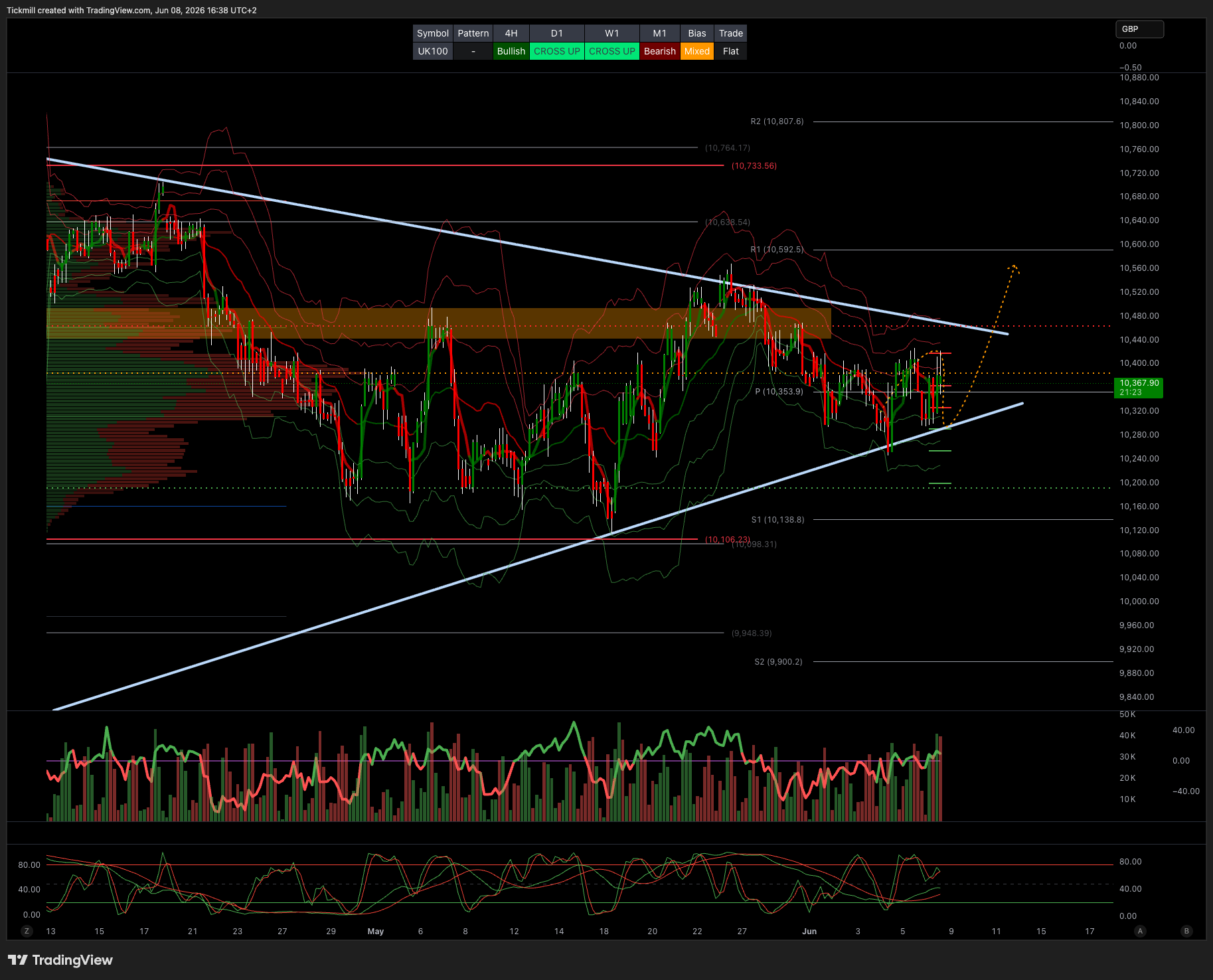
TECHNICAL & TRADE VIEW – FTSE100
Daily VWAP Bullish
Weekly VWAP Bullish
Above 10500 Target 11000
Below 10100 Target 9469
Disclaimer: The material provided is for information purposes only and should not be considered as investment advice. The views, information, or opinions expressed in the text belong solely to the author, and not to the author’s employer, organization, committee or other group or individual or company.
Past performance is not indicative of future results.
High Risk Warning: CFDs are complex instruments and come with a high risk of losing money rapidly due to leverage. 69% and 73% of retail investor accounts lose money when trading CFDs with Tickmill UK Ltd and Tickmill Europe Ltd respectively. You should consider whether you understand how CFDs work and whether you can afford to take the high risk of losing your money.
Futures and Options: Trading futures and options on margin carries a high degree of risk and may result in losses exceeding your initial investment. These products are not suitable for all investors. Ensure you fully understand the risks and take appropriate care to manage your risk.
Patrick has been involved in the financial markets for well over a decade as a self-educated professional trader and money manager. Flitting between the roles of market commentator, analyst and mentor, Patrick has improved the technical skills and psychological stance of literally hundreds of traders – coaching them to become savvy market operators!